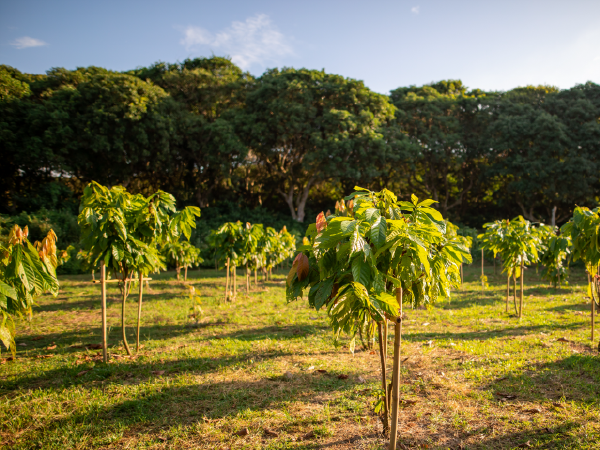
The cocoa industry has a long history of voluntary sustainability certification. Traders and manufacturers are therefore already used to working with multiple certification schemes across complex supply chains.
Now, the pressure to source responsibly and sustainably is coming as much from legislation as from consumers and internal motivations. Today, we are looking at the EU Deforestation Regulation (EUDR) and considering the impact this new piece of legislation will have on cocoa traders and manufacturers.
What is the EU Deforestation Regulation (EUDR)?
The EU Deforestation Regulation does not only apply to cocoa. It has been brought in to address deforestation in several commodities, including cocoa, cattle, coffee, palm oil (& derivatives), soya, wood, rubber, charcoal and paper products. It was adopted in May 2023, and traders have 18 months from that date to ensure compliance.
Companies will only be allowed to sell products across these commodities in the EU if the supplier has issued a due diligence statement confirming that the product does not come from deforested land. Companies will also have to verify that these products comply with relevant legislation in the growing country, such as on human rights, and that the rights of indigenous people have been respected.
Countries, and areas within them, will be classified as low-, standard- or high-risk, and products will face different due diligence processes based on these classifications. Non-compliance will be a serious risk to traders as the maximum fine will be at least 4% of the non-compliant entity’s annual turnover in the EU.
And as with many traceability initiatives, even if your organisation is not based in, or selling into, the EU, if your clients operate within the bloc, you may still find that you need to improve your traceability processes for your clients’ compliance with the legislation.
Challenges for cocoa traders
The first challenge is highlighted by the European Commission, who state that operators will need to have traceability down to the plot of land the product was grown on as authorities will likely combine geolocation with remote monitoring via satellite images to check compliance.
This data issue is a particular challenge in the cocoa industry, where the majority of production takes place on smallholdings, and as was recently discussed in a sustainability panel, these producers are less likely to have the resources to meet any additional reporting burden. And as well as accessing this traceability data, cocoa traders form only part of the supply chain so need to ensure they have the processes and technology in place to manage traceability across their operations and share this essential information with clients.
Risk management in cocoa compliance
The European Commission states that organisations who will be affected by the new legislation should conduct a risk assessment on all products that will fall under the scope of the EUDR. This risk assessment may include using satellite data to ensure growing areas are not subject to deforestation.
But remember, the EUDR also covers compliance with local laws so this would not be enough on its own. This means that if cocoa traders are to ensure compliance, they will need to evaluate their current suppliers as part of this risk assessment.
It is also important to consider new counterparty onboarding and how this process may need to be improved. You may need to implement a new supplier code of conduct, mandate certain certifications in some locations, or conduct a more comprehensive supplier audit at the onboarding stage.
And as with any form of risk management, these actions are not “one and done”. Your organisation will need to determine how the risks will be managed in an ongoing manner, including how regularly reviews or re-auditing will need to take place, and how this will be controlled internally.
Can technology solve the problem?
There are several Commodity Management technologies that can help cocoa traders improve their traceability, manage risk, and promote compliance within their business.
Supplier and grower auditing
Going right to the point of origination, Gen10’s Aud.IT app allows commodity traders and inspection companies to digitally audit local suppliers, completing the client’s audit questionnaire on-site, and uploading the results when they have Internet access. This means that data is verifiable and available across your organisation as soon as it is uploaded, with no need for paper documents and the risks they create. Aud.IT also allows your inspectors to add photographic evidence and uses the device’s location to add geolocation data.
Find out more about Aud.IT – download the case study now
Managing cocoa traceability data
Once you have the information you need from growers, this needs to be managed across your trading processes. This is where Gen10’s CommOS comes in. CommOS is a complete Commodity Management tool, incorporating logistics and operational risk alongside comprehensive contract and risk management, and the features of a traditional CTRM.
Because logistics is incorporated into CommOS alongside all your other operations, managing information across your processes is incredibly straightforward. As beans are allocated to contracts, shipments, or transformed into semi-finished products, this is all updated within CommOS without any additional administration.
So any data associated with the inbound shipment is automatically carried forward across your entire operation. This means that you have a complete digital audit of all sustainability data and can confidently and easily share this information with counterparties when requested.
Workflows and controls
CommOS also includes several features to ensure ongoing compliance with your risk management processes. As well as managing stock certifications, you can assign certificates to given counterparties, and can set alerts to notify your team when they are due to expire, to ensure a smooth, reliable renewals process.
Automated system alerts and controls can be used for several other aspects of risk management too, including alerting operators when stock doesn’t match a contract’s specification, such as not having the correct traceability data for the contract. And they can also be used to ensure that any deals your trading team create are within your various risk tolerances.
CommOS also includes process controls which can be set up in automated workflows specific to your business. These controls are helpful for a wide range of risks, including compliance risk. Not only do they share information across the organisation wherever it is needed, they can be used to ensure your processes are followed. From automatically sending contracts to the correct approval workflow to creating shipping documents, these process controls accelerate your operations whilst providing better risk management.
Counterparty onboarding
The automated workflows and controls are also essential in providing a smooth path for counterparty onboarding. The CRM module within CommOS keeps track of all your essential counterparty information and can be used to ensure you have all the information and certificates you need to begin deal-making. And, as above, approval workflows mean that all new counterparties can be progressed through your chosen approval channels before any actions are carried out, providing assurance that all due diligence has been completed.
Conclusion
The EU Deforestation Regulation represents a big change in ESG and compliance across many commodities, including cocoa. Ensuring you are compliant with this legislation and have the documents and data to demonstrate that compliance will be important for both your organisation and your clients operating in the EU. With the high cost of non-compliance, experts are recommending organisations conduct a thorough risk assessment, ensure they have access to the data they need, and analyse this data for themselves, either in-house or through an expert partner.
And the clock is ticking on getting this traceability data and the systems to manage it in place. The good news is that there are already solutions available that can make it easier to gather, manage, analyse and securely share this data. Speak to us today to explore how Gen10’s Commodity Management solutions can support your business’ traceability journey.