AI
The Art of AI in Commodity Trading: Key Takeaways from Commodity Trading Week APAC
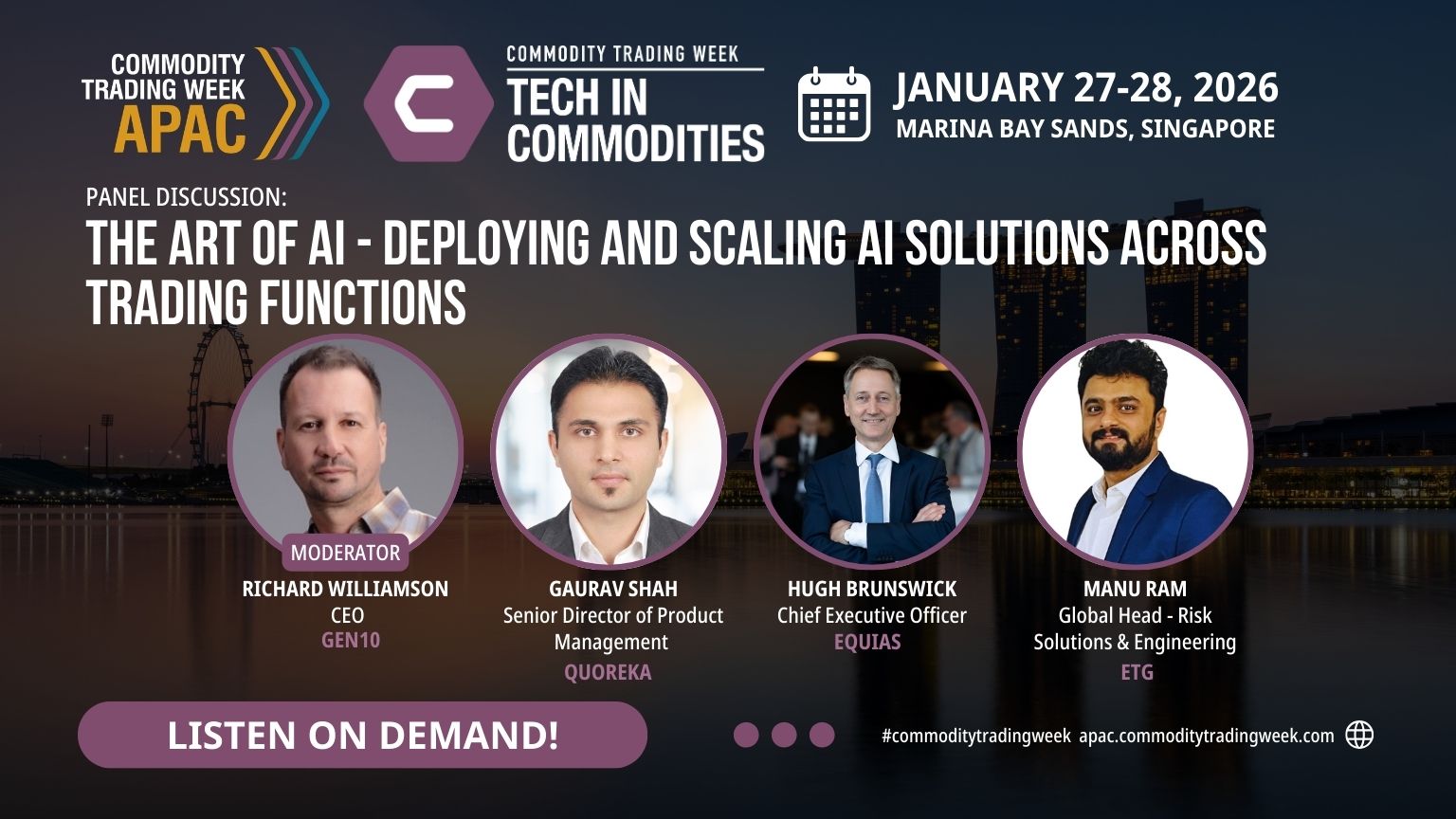
In January, Gen10 founder and CEO Richard Williamson took to the stage at Commodity Trading Week APAC to moderate a panel on one of the industry's most talked-about topics: Artificial Intelligence.
Joined by Hugh Brunswick (CEO, Equias), Gaurav Shah (Quoreka), and Manu Ram (Head of Risk Solutions, ETG), The Art of AI cut through the hype to explore where commodity trading firms are actually deploying AI, where it provides the best returns right now, and what it takes to get it right.
Where Is the Industry, Really?
Before the discussion got underway, the panel conducted two audience polls.
On the question of whether firms have a defined AI strategy, 22% said yes. The largest group, 39%, said this is in progress, with a further 28% planning to develop one. Surprisingly, 11% said they are not planning to develop an AI strategy at all.
The picture on how far adoption has progressed was also revealing. A third of respondents (33%) said they are already working with agentic AI and integrated solutions, a figure that visibly surprised the panel. A further 19% are still experimenting, while generative AI, market research, and data extraction each accounted for around 14%.
The takeaway: the industry is moving faster than many assume, but it is doing so unevenly, and for most firms, the hardest work is still ahead.
Where are traders using AI right now?
Several practical use cases that are already showing results emerged across the discussion.
Document processing was the most consistent theme. All panellists talked about automating unstructured physical document processing as a clear early win. Where there is a need to reconcile documents, extract data, and highlight exceptions or mismatches, AI delivers measurable value. If you’d like to understand what this looks like in practice, speak to the Gen10 team for a demo of the AI features in CommOS.
Conversational AI is making things simpler for end users. ETG has built an in-house tool, the Commodity Risk Assistant, that allows traders and senior leadership to query live positions, P&L, and forward exposure in natural language. This is similar to Gen10’s own approach of seamlessly integrating AI tools and chatbots directly into CommOS so that users can incorporate AI into their workflows without the need for more systems or interfaces.
Incorporating new data insights was showcased in a nuanced example from Hugh at Equias. By analysing email metadata patterns, their AI example can surface patterns that humans only begin to pick up and help traders understand counterparties, priorities, and documents in new ways.
Supply chain optimisation is where Gen10 have always focused our software efforts and where ETG is pushing AI furthest. Manu explained how, in their cocoa business, AI is being used to match purchase and sale contract optionality to identify maximum profit across open positions, but still relies on a human trader for the actual decision-making.
Where AI Is Not the Answer
One of the most valuable parts of the session was the frank discussion about where AI does not belong - at least not yet.
Manu gave a grounded example. A trader had requested an AI tool to generate contract document templates by counterparty. But this could be achieved by configuring the CTRM they already had.
This is why it is important to work with your CTRM provider when looking into AI solutions. In Gen10’s case, we focus on providing pragmatic AI solutions that solve specific problems our clients are facing, and work with clients to explore the best solution to the actual problem, rather than assuming AI is the best solution from the get-go.
The panel also highlighted how the role of AI is not to replace human judgement in trading decisions. It can extract data and create tools or checklists to help traders work faster, and make faster decisions, but AI cannot replace human traders.
The Data Problem Has Not Gone Away
Every use case discussed came back to the same foundation: data quality. As Richard put it, without clean, structured, well-defined data, AI is hamstrung. And so is the company trying to use it.
For firms still managing significant data in spreadsheets or unstructured formats, the panel's message was clear: AI will not fix the underlying problem, and may make it harder to see.
The semantic layer matters too. A chatbot querying a CTRM does not actually understand what "open mark-to-market" or "draft contract status" actually means in the context of that specific business, and how these definitions can vary between teams. For example, a trader’s definition of open contracts can be different to an operator’s. Without that definitional layer, the results will be fast, confident, and wrong.
The Art of Governance
As AI moves from experimentation into workflow integration, governance becomes non-negotiable.
Role-based access controls from core applications should carry through to AI tools automatically. Internal AI policies, protecting confidential trading data in closed AI environments, are essential before any experimentation begins.
Guardrails should prevent out-of-scope queries. All queries and responses should be logged so that decisions made based on AI output can be audited. The "answer is 42" problem, as Richard framed it, is a real governance risk if nobody has recorded how that answer was reached.
Cybersecurity considerations are also escalating alongside AI adoption. Manu noted that malware which previously took days to build can now be created in minutes. And it was pointed out that the more systems in use, particularly if they are disconnected from each other, the more red flags arise during actual audits.
Managing Costs and ROI
Infrastructure costs to run and maintain AI models are ongoing. Token costs can compound quickly if access is unrestricted or queries are poorly designed.
Practical advice from the panel included: limit access in the early stages; cache responses where possible; use smaller, cheaper models for simpler tasks rather than deploying a large LLM for every query; and build cost architecture into the solution design from day one, not after launch.
ROI, for now, is largely measured in operational efficiency. Capacity increased without additional headcount, or back-office processes that no longer require manual intervention.
Five Years From Here
The panel closed with a question on direction of travel. The consensus was cautiously optimistic, but clear that we just don’t know how transformative AI will be.
Hugh drew a parallel with the early internet: nobody in 2000 could have predicted what the following decade would bring, but it was clearly transformative. Gaurav pointed to cloud computing - eight years ago it was a selling point; now it is a baseline requirement in RFPs. AI is following the same arc, and faster. Manu's view was that for physical commodity trading, AI will be an enabler rather than a disruptor. Personal relationships and human judgement remain central to winning and retaining business, but AI will sharpen the tools that support those decisions.
The consistent thread across all three responses: the interesting use cases will not be found by AI. They will be found by people who understand their business well enough to know where the problems are. And they will be built on a data foundation solid enough to make those use cases work.
Embed AI in your operations with Gen10
At Gen10, we have been building AI capabilities directly into CommOS as tools embedded in the workflows your team already uses. From AI-assisted document processing and intelligent contract data extraction to conversational querying of your live positions, our approach is grounded in solving specific, practical problems for commodity businesses.
If you’d like to see what that looks like in the context of your own trading operations, book a demo with the Gen10 team. Every demo is built around your scenarios, your data challenges, and your workflows, not a generic walkthrough. We’ll show you exactly where AI fits, and where it doesn’t.