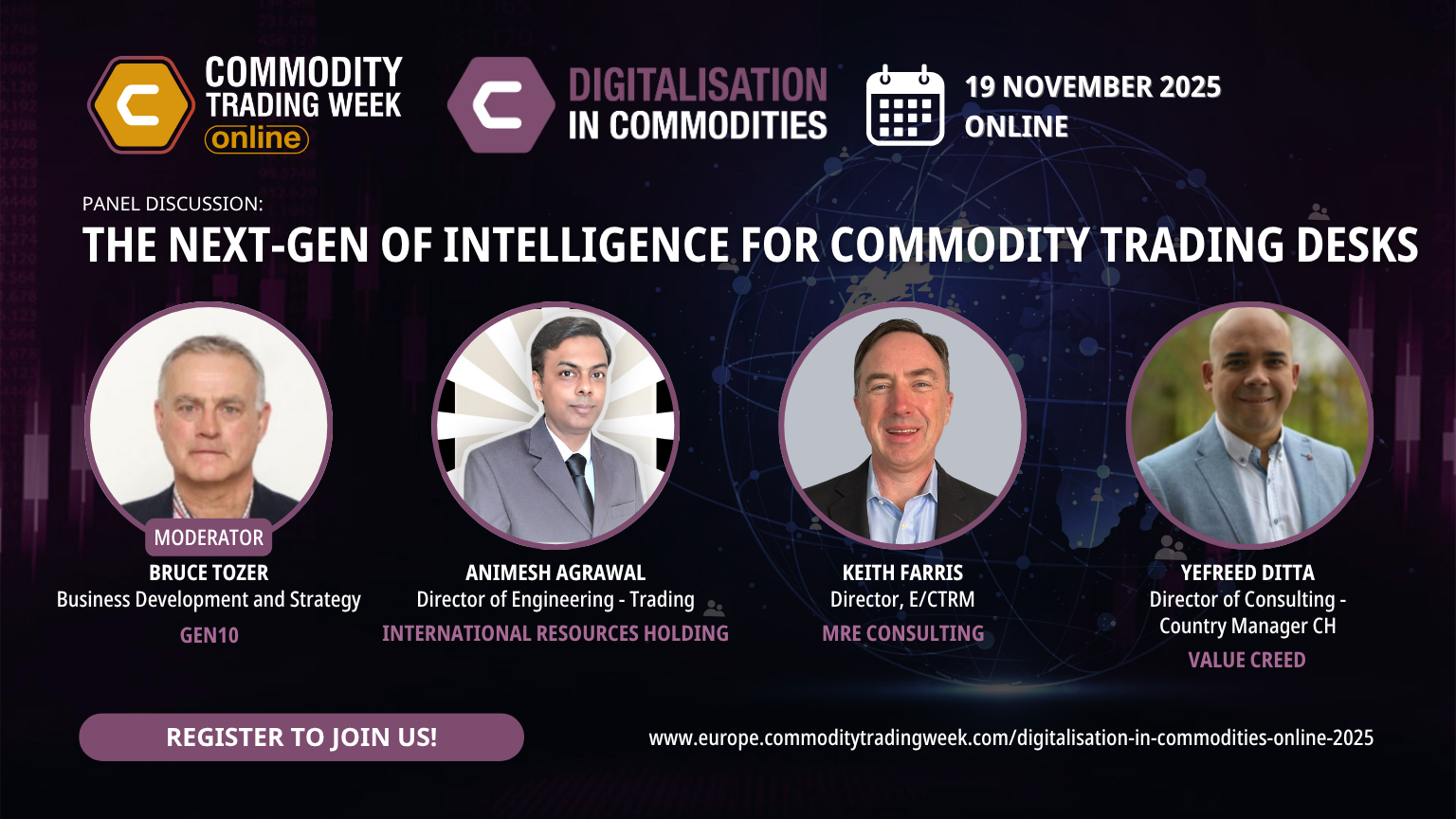
In November, Gen10’s Bruce Tozer chaired the panel The Next-Gen of Intelligence for Commodity Trading Desks as part of Digitalisation in Commodities Online. The discussion explored how commodity organisations can digitalise their trading data, embed AI into daily workflows, and use technology to drive operational excellence and smarter risk management.
Below, we’ve summarised the discussion into three key themes that emerged across the panel’s insights:
- People and organisational change
- Operational efficiency
- Risk modelling
People and organisational change
One of the first issues the panel addressed was the concern across trading organisations about how AI will reshape roles and responsibilities. While fears around automation are understandable, the consensus was clear: AI does not replace human expertise – it amplifies it.
Generative AI (GenAI) unlocks significant productivity gains, but it still relies on people with deep industry knowledge to innovate, challenge assumptions, and validate outputs. Large Language Models can boost productivity, but they require teams who understand commodity contracts, risk structures, and operational processes to guide and contextualise their work.
The panel emphasised that successful AI adoption requires democratising innovation across the organisation. Instead of relying on a single technical team to “swoop in” with solutions, companies need to make tools accessible and usable across departments. When people can experiment independently, they become more confident, creative, and invested in transformation.
At a strategic level, the pace of technological change makes forward-thinking essential. Leaders now need to look beyond immediate workflow improvements to anticipate how data, automation, and decision-support tools will reshape trading operations in the coming years.
Central to this is building a precise value case and recognising the importance of internal data. In commodities, internal data is the lifeblood of the organisation and provides more actionable value than external sources. External datasets remain complementary, but real competitive advantage comes from structuring, understanding, and leveraging your own information.
Operational efficiency
AI’s most visible impact today lies in operational efficiency. And there is no denying that AI can help you execute trades faster. Tasks that once required hours of manual effort – from generating reports to extracting contract details – can now be completed in minutes.
Many organisations instinctively prioritise revenue-generating initiatives, but the panel noted that the biggest immediate ROI often comes from cost savings. With AI now attracting stronger executive interest, efficiency and automation projects are receiving more internal attention and resources.
A key point raised was the scale of financial risks created by operational failures. The largest losses within commodity operations often come not from market movements but from mistakes: a missed update, an incorrect data entry, or a misinterpreted contract clause. AI reduces these risks by standardising processes and eliminating repetitive manual work.
The panel also highlighted the importance of ensuring that AI-generated data flows seamlessly back-and-forth with existing E/CTRM systems. AI can only create meaningful business value when its outputs integrate into the broader risk evaluation, settlement, and reporting processes.
Ultimately, organisations benefit from two sides of AI’s operational impact: fewer errors and significantly increased efficiency. Together, these improvements deliver measurable value across the trading desk, middle office, and operations teams.
Risk modelling
Risk modelling emerged as one of the strongest use cases for AI. AI can enhance modelling by analysing historical data, identifying patterns, and automating data extraction. However, the panel stressed that modelling is only as strong as the data and domain understanding behind it.
Risk modelling is evolving beyond simple price-based metrics. Commodity traders are increasingly using AI to incorporate satellite imagery, weather forecasts, shipping data, and other diverse datasets. AI tools can now extract values from PDFs, emails, and unstructured documents, normalise them, and plug them into visualisation and reporting systems.
However, AI cannot replace the nuanced judgement of experienced risk professionals. Complex scenarios – such as geopolitical shocks, supply chain disruptions, or shipping accidents – require a deep understanding of context, not just data patterns. These are the areas where AI can support analysis, but humans must guide interpretation and decision-making.
The biggest opportunities arise when organisations truly understand the value behind their data: what they have, what they need, and how each dataset contributes to risk modelling. Without this understanding, it becomes impossible to normalise data effectively or generate reliable insights.
Conclusion
The panel session raised several interesting considerations about the value and future of AI in commodity trading. AI is already changing the way organisations think about their data, digitalisation, and the human expertise that makes all this possible. It’s an exciting time to be working with AI in commodities, with many opportunities to enhance performance, reduce risk, and unlock operational value.
But the enduring truth remains: data is the real challenge – and the real advantage. Without accurate, timely, and accessible data, neither people nor AI models can produce meaningful insights. This is why a truly real-time, collaborative Commodity Management System is more important in the age of commodities AI than ever before.