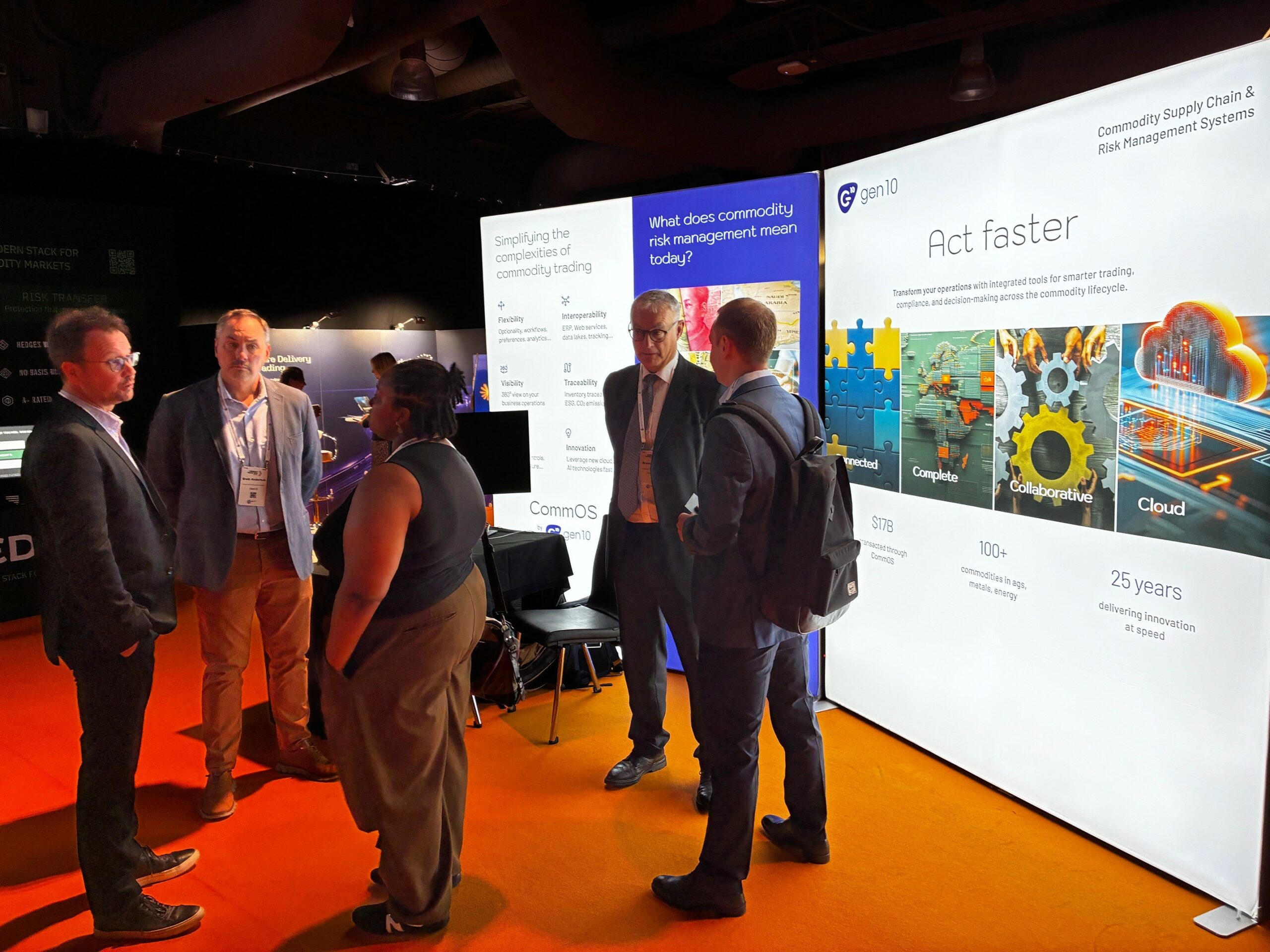
Commodity Trading Week Europe returned to Stamford Bridge for its 2026 edition in May, bringing together traders, technologists, risk managers, and supply chain specialists from across the global commodities industry.
The panel conversations across both days reflected an industry in a measured mood. Panellists were less focused on optimistic goals such as the energy transition, and more sharply concentrated on securing supply, managing risk, and building resilient operations.
But our conversations outside of the panels were full of buzz and excitement like never before. AI is proving to be a pivotal technology in commodities, and whilst there is a degree of healthy scepticism, it is definitely driving the industry to consider the technologies they are using and how they could be getting more from their supply chain systems.
Security of supply has replaced the energy transition as the dominant concern
A few years ago, there was a genuine sense of possibility around agricultural innovation, the green transition, and renewable energy infrastructure. That optimism hasn’t disappeared, but it has been tempered.
In 2026, the dominant theme, running through the critical minerals discussions, the risk sessions, and the market panels, was security of supply. Copper, essential to EVs, AI data centres, and solar infrastructure, faces supply constraints that are growing faster than new mining capacity can address. The narrative around recycling has followed a similar trajectory: it is no longer a sustainability aspiration, but a strategic necessity, driven by both market forces and policy.
The mood on AI is bullish, but sensible
The mood on AI was genuinely positive: the debate has moved decisively on from “is it hype?” to “how do we get it right?”
But when the audience was polled during the From concept to competitive edge AI panel session, only around 15% felt they were ahead on AI. Roughly 40% felt behind, and a similar number were unsure where they stood.
That result is worth digging into. We don’t think it reflects that most organisations are actually behind their competitors on AI adoption. We think it means people are measuring themselves against the potential they can see AI having, not just against the market. They are looking at what agentic AI could do for their operations and recognising that they aren’t there yet.
Your data strategy is your AI strategy
This point came through clearly in every AI-focused session we attended and participated in: the organisations that will get the most from AI are the ones that have invested in getting their data right first.
That means a single source of truth. It means properly governed, structured, commodity-specific data. Not spreadsheets, not disconnected point solutions, not data lakes that sit outside your operational systems. Richard Williamson, Gen10’s CEO, put it plainly during his panel: “If AI can’t understand your data, it can’t help you.”
And trading firms seem to have already come to this conclusion. We are seeing a real increase in interest in CTRM and Commodity Management solutions, with companies looking for systems that truly understand the complexities of each individual commodity and work within their workflows. The organisations asking questions about CommOS are thinking ahead, recognising that a properly implemented Commodity Management System provides the grounding for an effective AI strategy.
AI point solutions continue to proliferate, and some are genuinely useful. But the risk that came up in multiple conversations is that poorly integrated point solutions, or AI solutions built on data lakes outside of the operational management systems, simply create AI silos on top of the existing data silos. The foundation matters.
Agentic AI is here, but trading firms need a control centre
The conversation has shifted noticeably from generative AI (summarising and extracting data) to agentic AI: systems that can carry out actual tasks in your workflows autonomously, from analysing procurement signals to contract generation, without requiring a human to trigger each step.
That shift brings real value. Panellists described use cases where AI is already handling tasks that previously required significant manual input; document checking, supply chain visibility, demand forecasting, supplier confidence scoring. All freeing up teams to focus on decisions rather than data collection.
But it also brings new responsibilities. Agentic AI operating across enterprise systems needs governance, oversight and controls.
And these challenges can be addressed. Gen10’s AI includes a control centre for your AI operations: a single environment where managers can create new AI agents, oversee which agents are active, what they have access to, which AI models are being used and where, and define where humans are needed.
It gives organisations the ability to move quickly with AI whilst maintaining the control and auditability that responsible deployment requires. Because as one panellist noted, if you can’t explain how a number was produced and replicate it, the output is useless.
Cost management sits within this orchestration layer too. Escalating token costs were cited as an underappreciated risk; having real-time visibility over where your AI budget is going, and the ability to set limits by task, as well as define the queries that don’t need to be AI-generated at all, is increasingly important as agentic use expands.
Commodities is, and will remain, a people business
For all the capability that AI brings, two days at CTW Europe reinforced something we believe strongly at Gen10: this is an industry built on human trust and judgement, and that will not change.
The panel discussions were full of examples where the human element was not just present but essential. AI is probabilistic and binary. Humans interpret ambiguity. They read silence in a negotiation. They apply experience that no model has been trained on.
Panellists described moving to a world of “decision architects”, people who use AI to synthesise information rapidly, but who apply commercial and contextual judgement that a model can’t replicate. People who know how to question the dataset, challenge the output, and bring something genuinely new into the loop will remain in demand.
There was a moment in Richard’s panel that captured this well: the observation that even as agentic AI handles more of the back-office mechanics, the graduates entering this industry will still need to understand how commodity trading actually works or they won’t know when something is wrong. Building institutional knowledge into systems, not just into people, is part of the answer. But so is hiring curious, questioning people and giving them the space to develop real commercial judgement.
What this means for your AI journey
If you came away from CTW Europe feeling that your organisation has work to do on AI, you are in good company. The point is not where you are today, but whether you are moving in the right direction.
The right direction starts with the data foundations. A Commodity Management System that gives you clean, structured data connected to your contracts, your supply chain, and your risk exposure, is the foundation on which everything else is built.
And if you’re not there, getting started doesn’t have to mean a long, complex implementation. CommOS comes with over 100 commodity-specific templates and workflows, built for the way trading and procurement actually operate, and ready to go live within minutes. We can demonstrate this using your own contracts – not a generic demo, but a live proof of how quickly your specific workflows can be up and running.
Above that, we give you the control centre to manage your AI implementation and operations: visibility over agents, access controls, model selection, cost management, and governance, all in one place.
Start the conversation
The most consistent message from CTW Europe 2026 was a simple one: start. Your strategy doesn’t need to be fully formed, you just need an honest assessment of where your biggest operational friction is.
The organisations that are making genuine progress aren’t necessarily the ones with the largest budgets. They’re the ones that picked a specific problem, built something real around it, and learned from what happened. Iteration, not perfection, is the pattern that keeps emerging.
If you’d like to talk through where AI could support your business right now, or the barriers holding back your AI ambitions, we’d love to have that conversation.